Low-Frequency (LF) emissions generally refer to electromagnetic signals in the frequency range of 30 kHz to 300 kHz. These emissions are often produced by electrical power systems, industrial machinery, and electronic circuits with large inductive or capacitive components. While LF emissions carry relatively low energy, they can still interfere with sensitive equipment such as communication systems, metering devices, and medical instruments. Understanding and controlling LF emissions is critical for maintaining electromagnetic compatibility (EMC) and ensuring reliable operation of nearby electronic systems.
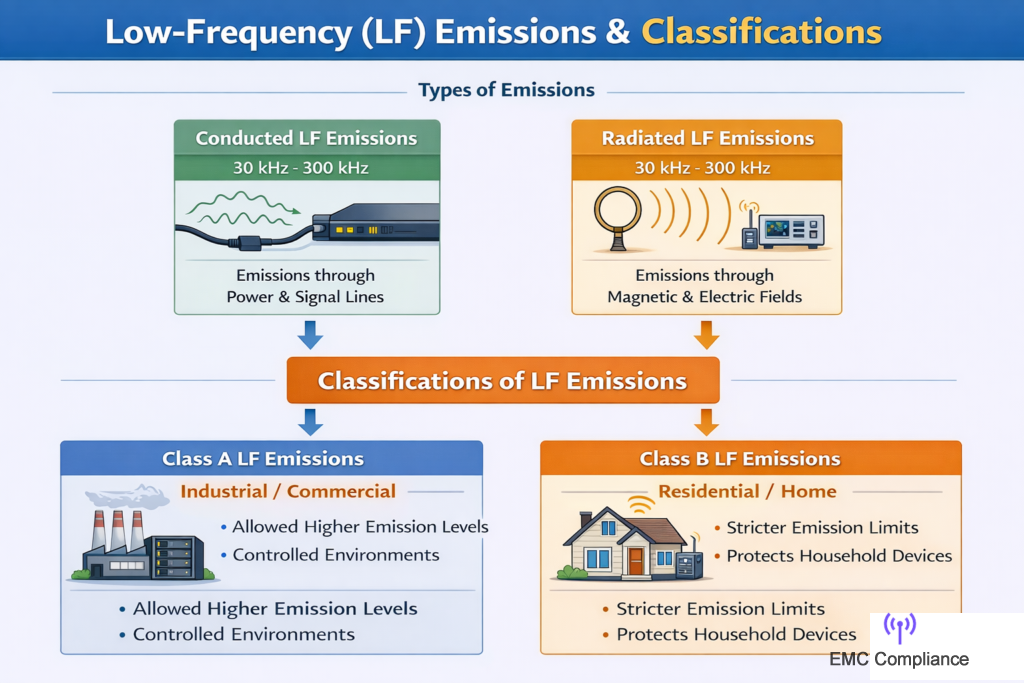
Classifications of LF emissions typically mirror the broader approach used in EMC standards, separating emissions by frequency, source, and intended environment. One common classification is by emission type: conducted LF emissions, which travel along power or signal lines, and radiated LF emissions, which propagate through space as magnetic or electric fields. Conducted LF emissions are often measured directly on cables using standard line impedance stabilization networks, while radiated LF emissions are assessed using loop antennas or magnetic probes.
LF emissions are also classified based on the operating environment of the equipment. Class A LF emissions are associated with industrial and commercial devices, which are allowed higher emission levels because they operate in controlled environments with trained personnel. Class B LF emissions apply to residential and home-use devices, where stricter limits are imposed to prevent interference with household electronics, radio receivers, and low-power communication devices. Proper measurement, filtering, and shielding techniques are essential to ensure that LF emissions remain within regulatory limits and do not disrupt other electronic systems.
Radiated Fields
Radiated LF fields are electromagnetic emissions that propagate through space from a source without requiring a physical conductor, typically in the frequency range of 30 kHz to 300 kHz. These emissions are primarily magnetic in nature due to the low frequency, meaning that the magnetic component of the electromagnetic wave dominates over the electric component at distances near the source. Radiated LF fields can originate from power lines, industrial equipment, transformers, and electronic devices with switching circuits, and they have the potential to interfere with nearby sensitive equipment, including communication devices, metering systems, and control circuits.
The propagation characteristics of LF radiated fields differ from higher-frequency emissions. At these frequencies, the wavelength is long (1 km to 10 km), so the fields tend to be more near-field dominated close to the source. In this near-field region, the strength of the magnetic field decreases with the cube of the distance from the source, while the electric field falls off more rapidly. This behavior influences both measurement techniques and mitigation strategies. LF radiated fields are typically measured using loop antennas, magnetic probes, or shielded enclosures to accurately capture the magnetic field component without interference from other sources.
Classification of radiated LF fields aligns with the broader EMC standards for emissions. Equipment is divided into Class A for industrial/commercial environments, which can tolerate higher emissions due to controlled conditions, and Class B for residential or home environments, where stricter limits are imposed to prevent interference with household electronics. Effective control of radiated LF fields involves shielding, proper grounding, filtering, and maintaining adequate separation between sources and sensitive devices. Understanding these fields is crucial for designers and engineers to ensure electromagnetic compatibility and compliance with regulatory standards, minimizing potential disruptions in both industrial and residential contexts.