
What is ATEX? Guidelines, legislation
ATEX Legislation refers to European Union directives that regulate equipment and work environments where there is a risk of explosion due to flammable gases, vapors, mists, or combustible dusts. “ATEX” comes from the French term “Atmosphères Explosibles.”
There are two main ATEX directives:
Key requirements:
- Equipment must be designed to prevent ignition sources.
- Products must be CE marked and accompanied by an EU Declaration of Conformity.
- Equipment is classified into Groups and Categories:
1) Group I: Equipment for mining (with methane and coal dust hazards).
2) Group II: Equipment for other explosive atmospheres (e.g., oil refineries, flour mills).
3) Categories (1, 2, 3) indicate protection levels, with Category 1 offering the highest.
The directives can be obtained here:
Directive 2014/34/EU of the European Parliament
Directive 1999/92/EC of the European Parliament
ATEX Directive 2014/34/EU (ATEX 114) – applies to the manufacturer/supplier of ATEX equipment
The ATEX 2014/34/EU directive which is also known as ATEX 114 is for all industries that supply equipment that are used in hazardous areas such as machinery and forklift trucks. This was previously known as ATEX 94/9/EC.
Equipment that operates in hazardous areas must comply with the requirements of ATEX 2014/34/EU directive.
ATEX equipment is built to a level of protection known as a category which matches the risk.
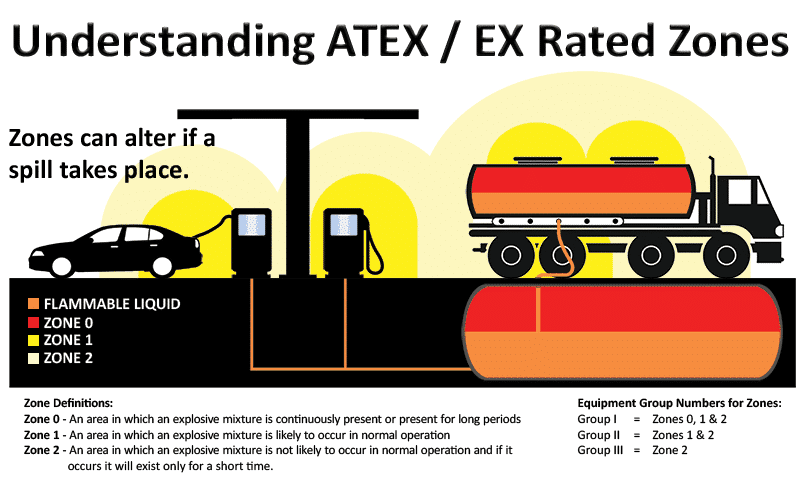
- ATEX Category 2G for Zone 1 hazardous areas
- ATEX Category 3G for Zone 2 hazardous areas
- ATEX Category 2D for Zone 21 hazardous areas
- ATEX Category 3D for Zone 22 hazardous areas
ATEX Directive 1999/92/EC (ATEX 153) – Sites with hazardous areas
ATEX 199/92/EC directive is for industries that operate within potentially explosive atmospheres such as chemical companies. This directive required companies to manage RISK and processes for safety. This is known as ATEX 153, previously as ATEX 137 or 99/92/EC – “Worker Protection Directive”.
ATEX Zone Classification, EPD and choosing ATEX Equipment
- Sites (such as a chemical plant, waste management site, oil and gas etc…) should classify the workplaces into hazardous area Zones depending on the frequency and time that an explosive atmosphere is present in the form of gas, vapour, powder or dust. For example:
-
- ATEX Zone 1 (high risk gas/vapour)
- ATEX Zone 2 (medium risk gas/vapour)
- ATEX Zone 21 (high-risk powder/dust)
- ATEX Zone 22 (medium risk powder/dust)
- Mark areas with Ex signs (also known as Ex Symbol or Ex marking) at point of entry
- Create and maintain an explosion protection document
- Select ATEX 2014/34/EU (ATEX 114) certified equipment according to the intended hazardous area Zones