Transient susceptibility refers to the vulnerability of electronic equipment to short-duration, high-amplitude disturbances in the electrical or electromagnetic environment. These disturbances, also called transients, can be caused by lightning strikes, power switching, electrostatic discharge (ESD), or sudden switching of inductive loads. Even though transients are brief, often lasting only microseconds to milliseconds, they can induce voltage or current spikes in circuits that may lead to malfunctions, data corruption, or permanent damage to sensitive components.
The effects of transient susceptibility vary depending on the design and robustness of the equipment. Devices with poor transient immunity may experience unexpected resets, system crashes, or incorrect operation during transient events. In critical systems, such as medical devices, industrial control systems, and communication infrastructure, transient susceptibility can pose significant safety and operational risks. Designers must consider both conducted transients, which travel through power or signal lines, and radiated transients, which propagate through space as electromagnetic pulses.
To mitigate transient susceptibility, engineers employ a range of design strategies and protective components. These include transient voltage suppressors, filters, ferrite beads, surge protectors, proper grounding, and shielding techniques. Standards such as IEC 61000-4-2 (ESD), IEC 61000-4-4 (fast transients), and IEC 61000-4-5 (surge) provide testing methods to evaluate equipment susceptibility and ensure compliance. By understanding and addressing transient susceptibility during the design phase, manufacturers can enhance the reliability, safety, and resilience of electronic systems in environments prone to electrical disturbances.
ETFB/Bursts
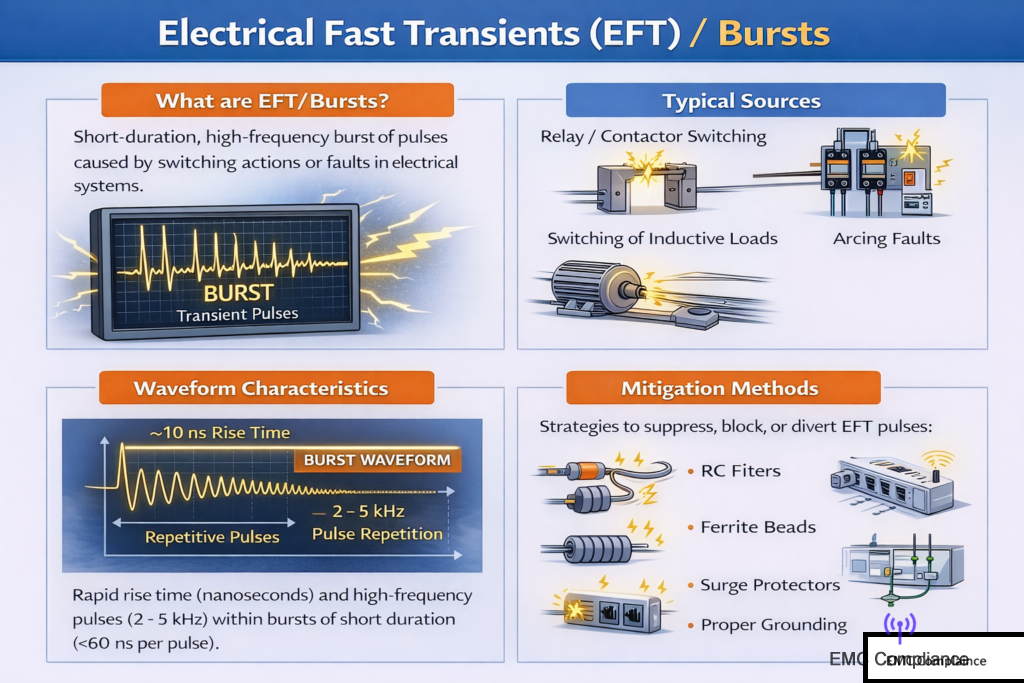
Electrical Fast Transients (EFT), also known as bursts, are short-duration, high-frequency disturbances that occur on power and signal lines. They are typically generated by switching operations in electrical circuits, such as the opening or closing of relays, contactors, or inductive loads, as well as from arcing or faults in industrial machinery. EFTs are characterized by rapid rise times (nanoseconds to microseconds) and repetitive pulses, often occurring in trains or bursts. Despite their brief duration, they can induce voltages that disrupt the normal operation of sensitive electronic devices, causing malfunctions, resets, or even permanent damage.
The nature of EFT bursts makes them particularly challenging to mitigate. Unlike continuous disturbances, EFTs are transient, high-energy events that can propagate along both power and signal lines, and may couple into nearby circuits via conduction or radiation. The frequency content of EFT bursts often spans from tens of kHz to several MHz, which can interfere with digital electronics, communication equipment, and control systems. The repetitive nature of bursts can exacerbate their effects, especially in systems with inadequate filtering or poor transient protection.
Mitigation and testing of EFT bursts are guided by international standards such as IEC 61000-4-4. Protective strategies include the use of surge suppressors, RC filters, ferrite beads, proper grounding, and layout design to reduce coupling paths. Devices are tested by applying controlled EFT bursts to simulate real-world conditions, ensuring that equipment maintains functionality and reliability even in harsh electromagnetic environments. Addressing EFT susceptibility during the design and testing phases is essential to maintain system integrity and comply with EMC regulations, particularly in industrial, automotive, and critical infrastructure applications.
Surges
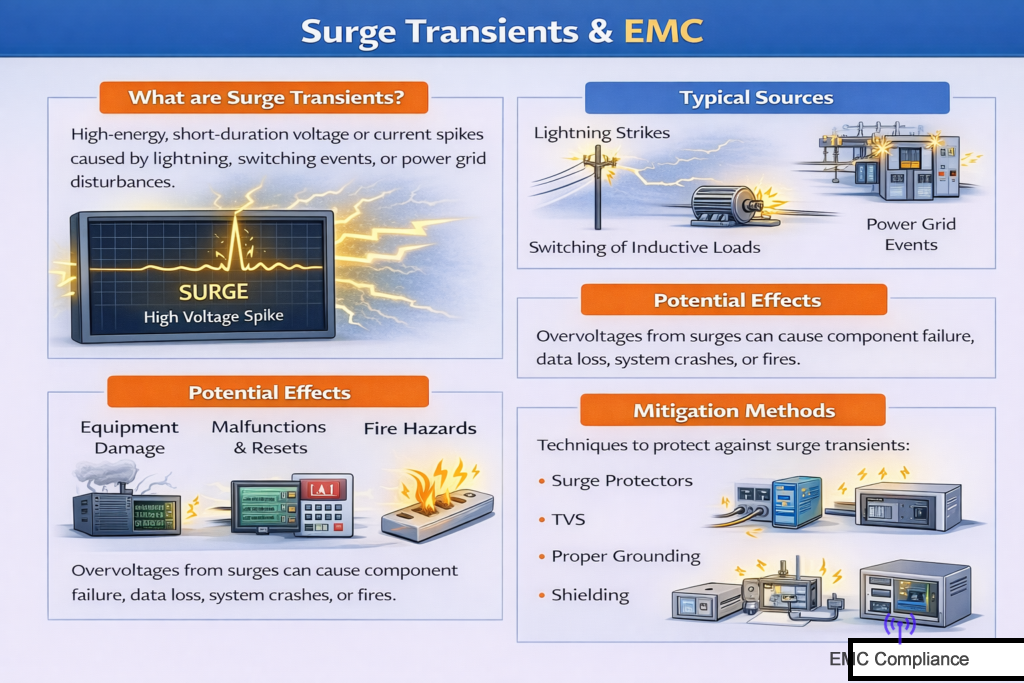
Surge transients are high-energy, short-duration voltage or current disturbances that occur in electrical and electronic systems. They are typically caused by external events, such as lightning strikes or switching operations in the power grid, and internal events, such as the switching of large inductive loads. Surge transients differ from other transient phenomena like EFT bursts because they generally carry much higher energy and can last longer (microseconds to milliseconds). These high-amplitude events can induce over voltages that exceed the withstand capacity of components, potentially leading to insulation breakdown, equipment damage, or complete system failure.
The impact of surge transients on EMC is significant because they can create both conducted and radiated disturbances. Conducted surges travel along power or signal lines, potentially affecting multiple connected devices, while radiated surges can couple into nearby circuits through electromagnetic fields. Sensitive electronic systems, such as communication equipment, industrial control systems, and medical devices, are particularly vulnerable. Without adequate protection, surge transients can cause malfunctions, data corruption, or long-term reliability issues, compromising both safety and performance.
Mitigation of surge transients is a key aspect of EMC design. Strategies include the use of surge protective devices (SPDs), transient voltage suppressors, proper grounding, shielding, and filtering. IEC 61000-4-5 defines standardized testing procedures for surge immunity, helping engineers ensure that devices can withstand realistic surge events while maintaining functionality. By integrating robust surge protection measures during design and installation, manufacturers can enhance system resilience, ensure regulatory compliance, and safeguard critical electronic equipment against unexpected high-energy disturbances.
ESD
Electrostatic Discharge (ESD) transient susceptibility refers to how vulnerable electronic equipment is to fast, high-voltage electrostatic discharge events. ESD occurs when a built-up static charge is suddenly released — for example, when a person touches a device after walking across a carpet. Although the energy involved may be small, the voltage can reach several thousand volts, creating extremely fast rise-time transients that can disrupt or damage sensitive electronics.
From a technical perspective, ESD transients are characterised by very short rise times (sub-nanosecond to nanosecond range) and high peak currents. These fast pulses can couple into circuits through direct contact, air discharge, or indirect paths such as cables, enclosures, and PCB traces. Susceptibility depends on factors such as PCB layout, grounding strategy, shielding, component selection, and enclosure design. Poor grounding, long trace lengths, high-impedance inputs, and inadequate filtering significantly increase vulnerability.
The effects of ESD susceptibility range from temporary malfunction (soft failure) to permanent component damage (hard failure). Soft failures may include system resets, data corruption, display glitches, or communication errors. Hard failures often involve semiconductor junction breakdown, degraded insulation, or latent damage that reduces long-term reliability. Even when no immediate failure is observed, repeated ESD exposure can weaken components over time.
Testing for ESD transient susceptibility is commonly performed using standardized methods such as IEC 61000-4-2, where controlled contact and air discharge events are applied to the equipment under test. These tests simulate real-world electrostatic events and assess both performance degradation and recovery capability. Mitigation techniques include proper PCB grounding, use of transient voltage suppressor (TVS) diodes, shielding, controlled impedance routing, filtering, and robust enclosure design.
Ultimately, managing ESD transient susceptibility is a critical part of EMC design and product reliability. Effective early-stage design controls significantly reduce compliance risks, product failures in the field, and costly redesigns later in development.
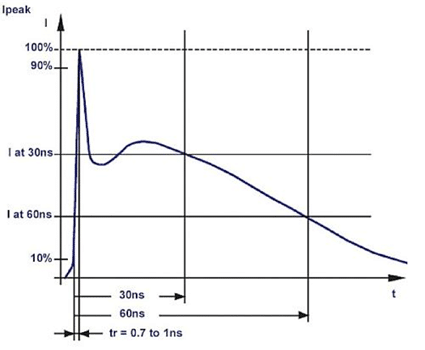
In an Electrostatic Discharge (ESD) event, although the total energy is relatively low, the current pulse can reach tens of amps for a very short duration. This occurs because ESD involves extremely high voltages — often several kilovolts — combined with very fast rise times (typically less than 1 nanosecond). When the discharge path is established, the stored electrostatic charge is released almost instantaneously, producing a sharp current spike that can momentarily reach 20–40 amps or more, depending on the discharge voltage and test conditions.
Under standard immunity testing such as IEC 61000-4-2, an 8 kV contact discharge can produce a peak current of approximately 30 amps with a rise time of around 0.7–1 ns. Despite lasting only tens of nanoseconds, this high peak current generates significant electromagnetic fields and rapid voltage drops across circuit impedances. Even small parasitic inductances in PCB traces or ground paths can create substantial voltage transients due to the high di/dt (rate of change of current), potentially upsetting or damaging sensitive components.
The short duration of the pulse does not make it harmless. Semiconductor junctions, high-impedance inputs, communication interfaces, and microcontroller pins are particularly vulnerable. The combination of high peak current and fast edge speed can cause dielectric breakdown, latch-up conditions, data corruption, or system resets. In some cases, the damage may be latent — components may continue functioning but suffer reduced long-term reliability.
Effective mitigation requires controlling both the current path and the transient energy. Low-impedance grounding, short return paths, proper PCB stack-up design, use of transient voltage suppressor (TVS) devices, and careful enclosure bonding all help divert the high current pulse away from sensitive circuitry. The key principle in ESD design is not eliminating the discharge — which is impossible in real-world environments — but safely managing the high-current transient so that it does not disrupt or damage the system.
The effect of a high transient current, such as that produced during an ESD event, is most severe in digital electronics because of their low operating voltages and tight noise margins. Modern digital circuits typically operate at 5 V, 3.3 V, or even below 1.2 V. When a fast, high-amplitude transient is coupled into these circuits, even a small induced voltage can exceed the logic threshold levels, causing unintended switching or logic errors. Compared to analogue systems, which often tolerate gradual disturbances, digital systems are highly sensitive to rapid voltage spikes.
High transient currents also produce very fast voltage changes due to parasitic inductance and impedance within PCB traces, ground planes, and interconnects. The relationship V=LdidtV = L \frac{di}{dt} means that even a few nanohenries of stray inductance can generate several volts of disturbance when subjected to the steep current rise of an ESD pulse. In high-speed digital designs, this can momentarily shift reference ground levels, creating ground bounce and false triggering in logic devices, microcontrollers, or communication interfaces.
Clocked systems are particularly vulnerable. A transient occurring near a clock edge can corrupt data in flip-flops or registers, leading to unpredictable behaviour. Microprocessors may reset, latch up, or execute unintended instructions. Communication buses such as SPI, I²C, USB, or Ethernet can experience data corruption or complete link failure. These effects are often classified as “soft failures,” but in safety-critical or industrial applications, even temporary malfunctions can have serious consequences.
In addition to immediate functional disruption, repeated exposure to high transient currents can stress semiconductor junctions and protection structures. While internal ESD protection diodes provide some defence, they are not designed to absorb repeated high-energy pulses beyond their specification. Over time, this can degrade device reliability or lead to latent failures.
For these reasons, digital electronics require careful transient management through robust grounding strategies, controlled PCB layout, decoupling, shielding, and external protection devices such as transient voltage suppressors. Designing with transient immunity in mind is essential to ensure stable operation and long-term reliability in real-world electromagnetic environments.