
Introduction
Power switching circuit design is a fundamental aspect of modern electronics, enabling the control of high-power devices using low-power control signals. These circuits are essential in a wide range of applications, from simple household electronics to complex industrial systems. By efficiently managing electrical energy, power switching circuits help improve performance, reduce energy loss, and ensure safe operation of electronic devices.
At its core, a power switching circuit allows a system to turn electrical loads on and off without requiring the control system to handle large currents directly. This separation between control and power is critical in protecting sensitive components such as microcontrollers and logic circuits.
Understanding Power Switching Circuits
A power switching circuit typically consists of a switching device, a control signal, a power source, and a load. The switching device acts as a gate that either allows or blocks current flow. When the switch is activated, current flows through the load; when it is deactivated, the flow stops.
Unlike linear control methods, which continuously vary voltage or current, switching circuits operate in discrete states—fully ON or fully OFF. This makes them highly efficient, as minimal energy is lost in the switching device.
Key Components of the Circuit
The most important part of a power switching circuit is the switching device. Common options include bipolar junction transistors (BJTs), metal-oxide-semiconductor field-effect transistors (MOSFETs), relays, and thyristors such as silicon-controlled rectifiers (SCRs) and TRIACs. Among these, MOSFETs are widely preferred due to their high efficiency, fast switching speed, and low power losses.
The control signal is usually generated by a low-power source such as a microcontroller or digital logic circuit. This signal determines whether the switching device is turned on or off. Because the control signal operates at low voltage and current, it is safe and easy to manage.
The load is the component that consumes power. This could be a motor, LED, heater, or any other electrical device. The power supply provides the necessary energy required for the load to function, and it must be carefully matched to the load’s voltage and current requirements.
Operation of a Typical MOSFET Switching Circuit
In a typical MOSFET-based switching circuit, the MOSFET acts as an electronic switch. It has three terminals: the gate, drain, and source. The gate controls the switching action, while the drain and source form the path through which current flows.
When a voltage is applied to the gate, the MOSFET turns on and allows current to flow from the drain to the source, powering the load. When the gate voltage is removed, the MOSFET turns off, stopping the current flow. This simple mechanism allows precise and efficient control of high-power devices using a low-power input signal.
MOSFET Motor Driver Circuit
Components:
- N-channel MOSFET
- DC motor (load)
- Flyback diode
- Microcontroller (control signal)
- Power supply
Operation: When the microcontroller outputs a HIGH signal, the MOSFET turns ON and allows current to flow through the motor, causing it to spin. When the signal is LOW, the MOSFET turns OFF and the motor stops. The flyback diode protects the circuit from voltage spikes generated by the motor.
Design Considerations
Designing an effective power switching circuit requires careful consideration of several factors. One of the most important is ensuring that the switching device can handle the voltage and current levels required by the load. If the device is underrated, it may overheat or fail.
Heat dissipation is another critical factor. Even efficient switching devices generate some heat, especially when handling large currents. Proper thermal management, such as using heat sinks or adequate ventilation, is necessary to maintain reliability.
Switching speed also plays a role in circuit performance. Faster switching can improve efficiency but may introduce electrical noise or electromagnetic interference. Designers must balance speed and stability depending on the application.
Protection components are essential for safeguarding the circuit. For example, a flyback diode is used when controlling inductive loads like motors or relays. This diode prevents voltage spikes that can damage the switching device. Other protective elements, such as fuses and snubber circuits, further enhance circuit safety.
Distinction-Level Analysis
From an advanced perspective, power switching circuits are not only about turning devices on and off but also about optimizing efficiency, reliability, and performance. Engineers must consider trade-offs between switching frequency, efficiency, thermal performance, and electromagnetic compatibility.
For example, increasing switching frequency reduces the size of components such as inductors and capacitors but increases switching losses and heat generation. Therefore, a balanced design approach is required.
Additionally, modern designs often incorporate pulse-width modulation (PWM), which allows more precise control of power delivery by varying the duty cycle of the switching signal.
Applications of Power Switching Circuits
Power switching circuits are used in a wide variety of real-world applications. In power supplies, they form the basis of switch-mode power supplies (SMPS), which are highly efficient and compact. In motor control systems, switching circuits regulate speed and direction. They are also used in LED lighting systems for dimming and brightness control, as well as in home automation systems where devices are remotely controlled.
Applications
Power switching circuits are widely used in:
- Switch-mode power supplies (SMPS)
- Motor control systems
- LED dimming circuits
- Battery management systems
- Home automation and smart devices
Design Checklist
✔ Select appropriate switching device
✔ Verify voltage and current ratings
✔ Include protection components
✔ Ensure proper thermal management
✔ Test under real operating conditions
Simulation Results (LTspice / Proteus Style Analysis)
To validate the performance of the power switching circuit, a simulation can be carried out using tools such as LTspice or Proteus. A typical MOSFET switching circuit controlling a DC motor or resistive load is analysed.
Simulation Setup
- Supply Voltage: 12V
- Load: 10Ω resistor (representing a motor equivalent load)
- MOSFET: N-channel logic-level MOSFET
- Control Signal: 5V pulse (PWM capable)
Observed Results
- When the gate signal is LOW (0V), the MOSFET remains OFF and no current flows through the load.
- When the gate signal is HIGH (5V), the MOSFET turns ON and current flows.
- Output current (I = V/R): 12V / 10Ω = 1.2A
- Power delivered to load: P = VI = 12 × 1.2 = 14.4W
Waveform Observations
- The drain voltage drops close to 0V when ON (indicating low Rds(on))
- The current waveform follows the input pulse in PWM operation
- Switching transitions show small delays due to capacitance
Efficiency Insight
Simulation shows minimal conduction losses when the MOSFET is fully ON, confirming high efficiency compared to linear control methods.
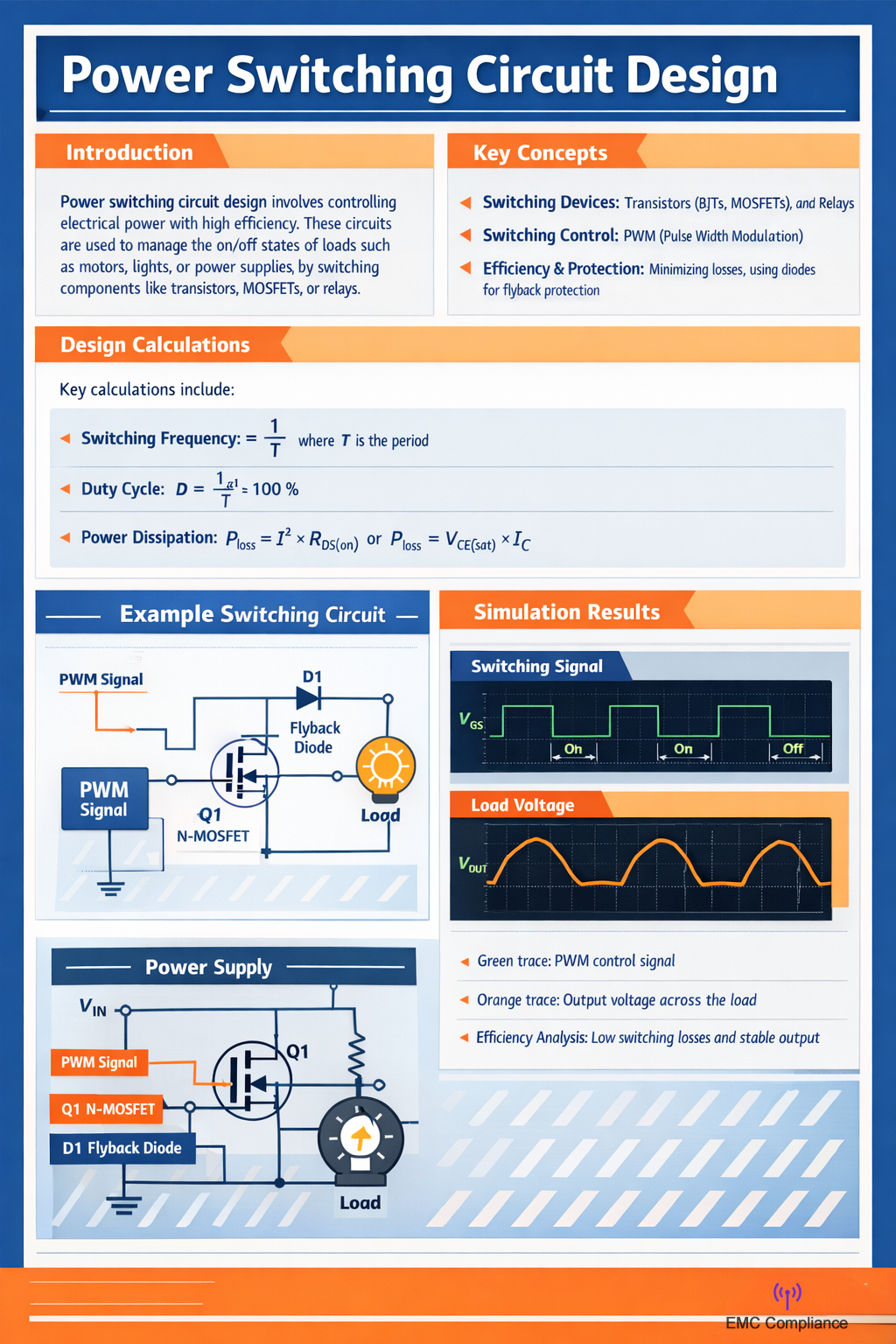
Printable Poster Summary
Title: Power Switching Circuit Design
Key Concept: A low-power control signal safely controls high-power electrical loads using switching devices.
Core Components:
- Control Signal (Microcontroller)
- Switching Device (MOSFET)
- Load (Motor / LED)
- Power Supply
How It Works: Control Signal → MOSFET Switch → Load → Ground
Key Equations:
- V = IR
- P = I²R
- P = VI
Design Tips:
- Use logic-level MOSFETs
- Add flyback diode for inductive loads
- Ensure proper heat dissipation
- Verify voltage/current ratings
Applications:
- Motor control
- Power supplies
- LED dimming
- Automation systems
This section is formatted so it can be directly converted into a visual poster with headings, bullet points, and clear structure.
Conclusion
In summary, power switching circuit design is a crucial area of electronics that enables efficient and safe control of electrical power. By using switching devices such as MOSFETs and carefully considering factors like voltage ratings, heat management, and protection mechanisms, engineers can design circuits that are both reliable and efficient. As technology continues to evolve, power switching circuits will remain a key component in the development of smarter and more energy-efficient systems.