CISPR 11
The IEC/CISPR 11, EN 55011 (Industrial, scientific and medical (ISM) radio-frequency equipment – Electromagnetic disturbance characteristics – Limits and methods of measurement) is about: Conducted and radiated emissions of signals in the frequency range of 9kHz to 400GHz.
Applicability.
Equipment covered by other CISPR product and product family emission standards are excluded from the scope of CISPR 11. CISPR 11 applies to industrial, scientific and medical electrical equipment operating in the frequency range 0Hz to 400GHz and to domestic and similar appliances designed to generate and/or use locally radio-frequency energy. CISPR 11 standard covers emission requirements related to radio-frequency (RF) disturbances in the frequency range of 9kHz to 400GHz. Measurements need only be performed in frequency ranges where limits are specified.
CISPR 11 and CISPR 14: Induction cooking is the scope of CISPR 14-1 and CISPR 14-2 [May-2019]. Microwave ovens are primarily the scope of CISPR 11 and CISPR 14-2 (however, be aware of multi-function equipment which may also be the scope of CISPR 14-1, e.g. for click measurement).
For ISM Radio-Frequency (RF) applications in the meaning of the definition found in the United Nations specialized agency for information and communication technologies (ITU) Radio Regulations, CISPR 11 covers emission requirements related to radio-frequency disturbances in the frequency range of 9kHz to 18GHz. Requirements for ISM RF lighting equipment and Ultra Violet (UV) radiators operating at frequencies within the ISM frequency bands defined by the ITU Radio Regulations are contained in CISPR 11.
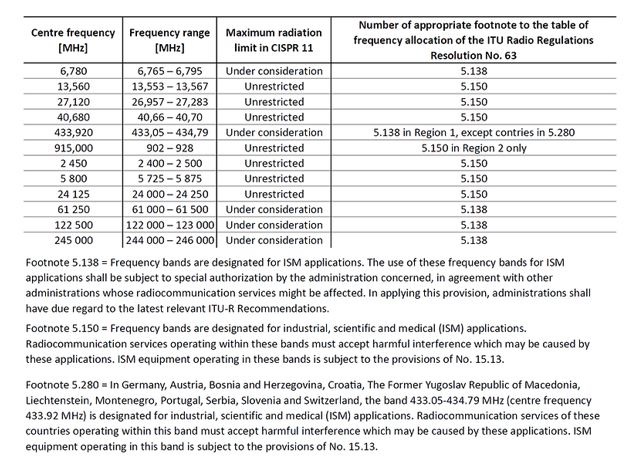
In the following, the term ISM band often appears (also in the FCC Part 18 section). In order to clarify things, here are some facts:
- The industrial, scientific and medical (ISM) radio bands are reserved internationally for the use of radio frequency (RF) energy for industrial, scientific and medical purposes other than telecommunications.
- ISM bands are defined by the ITU Radio Regulations (article 5) in footnotes 5.138, 5.150, and 5.280 of the Radio Regulations.
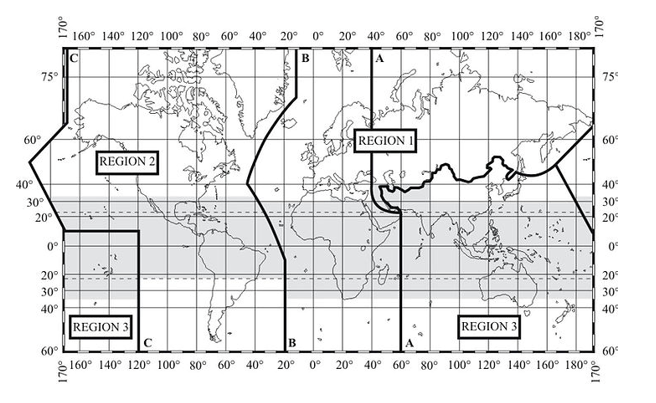
- Not all ISM frequency bands are harmonized worldwide. Some apply only to certain regions (see below).
Groups.
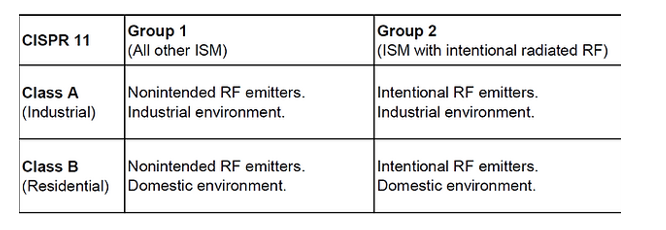
There are two groups of ISM equipment defined in CISPR 11:
Group 1 (general purpose applications, class A or class B): All equipment in the scope of CISPR 11 which is not classified as Group 2 equipment. Examples of Group 1 equipment:
-
- Laboratory equipment
- Medical electrical equipment
- Scientific equipment
- Semiconductor-converters
- Industrial electric heating equipment with operating frequencies less than or equal to 9 kHz
- Machine tools
- Industrial process measurement and control equipment
- Semiconductor manufacturing equipment
- Switch mode power supplies
Group 2 (ISM RF applications, class A or class B): All ISM RF equipment in which radio-frequency energy in the frequency range 9kHz to 400GHz is intentionally generated and used or only used locally, in the form of electromagnetic radiation, inductive and/or capacitive coupling, for the treatment of material, for inspection/analysis purposes, or for transfer of electromagnetic energy. Examples of Group 2 equipment:
-
- Microwave-powered UV irradiating apparatus
- Microwave lighting apparatus
- Industrial induction heating equipment operating at frequencies above 9 kHz
- Dielectric heating equipment Industrial microwave heating equipment
- Arc Welding equipment
- Microwave ovens
- Medical electrical equipment
- Electric welding equipment
- Electro-discharge machining (EDM) equipment
- Demonstration models for education and training
- Battery chargers and power supplies – wireless power transfer (WPT) mode
Classification.
There are two classes of ISM equipment defined in CISPR 11:
- Class A (higher emission limits, industrial): Class A devices are devices that are suitable for use in all areas other than residential and such areas, and they are connected to the public mains.
Devices must have emissions which are below the limits of Class A, but the emissions may exceed the limits of Class B.
For Class A equipment, the instructions for use accompanying the product shall contain the following text: Caution: This equipment is not intended for use in residential environments and may not provide adequate protection to radio reception in such environments. - Class B (lower emission limits, residential): Class B devices are devices that are suitable for use in residential areas and such areas, and they are connected to the public mains.
Test Setup.
Test location:
Class A. Class A equipment may be measured either on a test site or in situ (at installation site) as preferred by the manufacturer. Due to size, complexity or operating conditions some equipment may have to be measured in situ in order to show compliance with the radiation disturbance limits.
Class B. Class B equipment shall be measured on a test site.
Measuring distance for radiated emissions:
Class A. On a test site, Class A equipment can be measured at a nominal distance d of 3m, 10m or 30m.
- Class A Group 1 equipment can be measured in situ, where the measurement takes place at a distance of 30m from the outer face of the exterior wall of the building in which the equipment is situated.
Class A Group 2 equipment can be measured in situ, where the measurement distance d from the exterior wall of the building in which the equipment is situated equals (30+x/a)m or 100m whichever is smaller, provided that the measuring distance d is within the boundary of the premises. In the case where the calculated distance d is beyond the boundary of the premises, the measuring distance d equals x or 30m, whichever is longer. For the calculation of the above values:- x is the nearest distance between the exterior wall of the building in which the equipment is situated and the boundary of the user’s premises in each measuring direction.
- a = 2.5 for frequencies lower than 1 MHz.
- a = 4.5 for frequencies equal to or higher than 1 MHz.
- Class B. On a test site, Class B equipment can be measured at a nominal distance d of 3m or 10m.
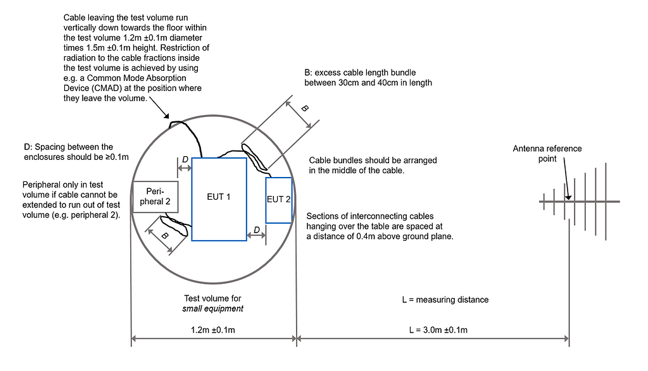
- d < 10m.In the frequency range 30MHz to 1000MHz, a distance less than 10m is allowed only for equipment which complies with the definition for small size equipment. Small size equipment is either positioned on a table top or standing on the floor which, including its cables fits in an imaginary cylindrical test volume of 1.2m in diameter and 1.5m height (to ground plane).
Consistent with typical applications of the equipment under test, the level of the disturbance shall be maximized by varying the configuration of the equipment.
An example of a typical setup for measurements of radiated disturbances from a table-top EUT is given below (top-view). The measurement arrangement shall be typical of normal installation practice and cantered to the turntable’s vertical axis.
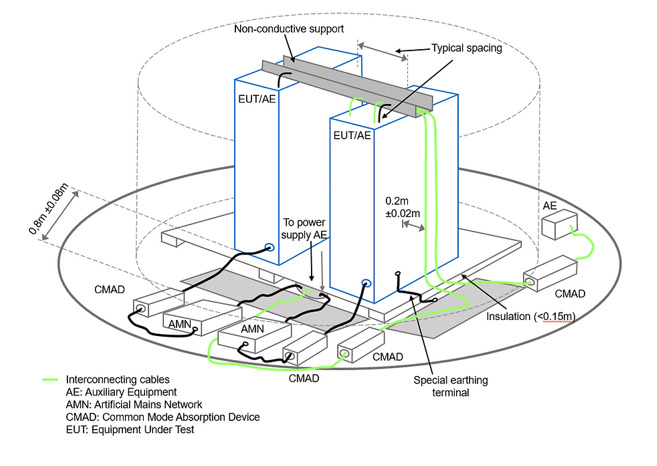
An example of a typical unified test set up for floor standing equipment suitable for measurement of conducted as well as radiated disturbances is shown below. Further examples of typical arrangements of the EUT and associated peripherals are given in CISPR 16-2-3 and CISPR 16-2-1.
Limits Test Site.
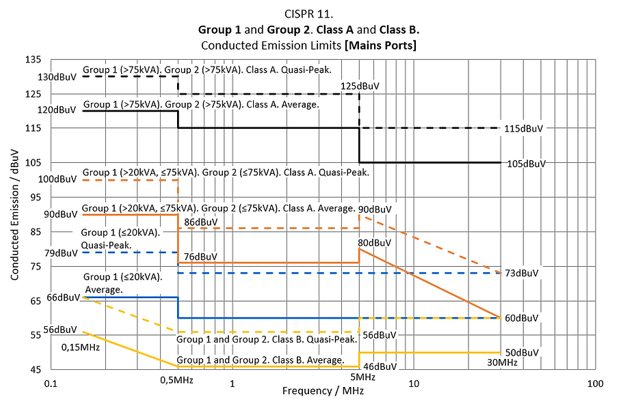
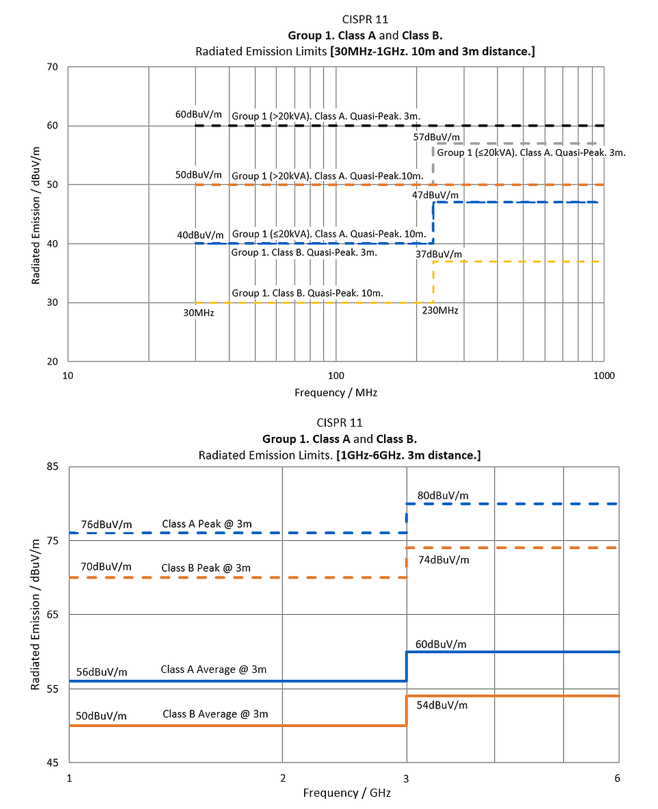
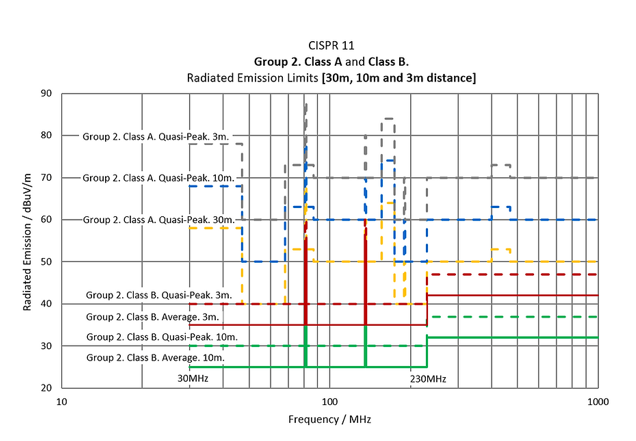
There are limits for conducted and radiated emissions specified in CISPR 11. Below, you can find the limits for measurements performed on a test site (not in situ).
CISPR 11 Group 1 @ Test Site:
- 9kHz to 150kHz. No limits specified.
- 150kHz to 30MHz. Conducted emissions limits – public mains power ports – Group 1 equipment (Class A and B).
Conducted emissions limits – DC power ports – Group 1 equipment (Class A and B). - 30MHz to 1GHz. Radiated emissions limits (30MHz to 1GHz) – Group 1 equipment (Class A and B).
- 1GHz to 18GHz. Radiated emissions limits (1GHz to 6GHz) – Group 1 equipment (Class A and B). In the frequency range 6GHz to 18GHz limits are not specified
- 18GHz to 400GHz. No limits specified.
CISPR 11 Group 2 @ Test Site:
- 9kHz to 150kHz. No limits specified.
- 150kHz to 30MHz. Conducted emissions limits – public mains power ports – Group 2 equipment (Class A and B).
- 30MHz to 1GHz. Radiated emissions limits – Group 2 equipment (Class A and B).
- 1GHz to 18GHz. The limits in the frequency range 1GHz to 18GHz apply only to Group 2 equipment operating at frequencies above 400MHz. The evaluation of the radiated emission limits is complicated and would go beyond the constraints of this website.
- 18GHz to 400GHz. No limits specified.
- ISM Frequencies. Be aware that CISPR 11 limits do not apply for ISM frequency bands (defined by ITU, see here). Outside of ITU designated ISM bands the limits for the disturbance voltage and radiation disturbance in CISPR 11 apply.

Limits in situ.
Under in situ conditions, an assessment of conducted disturbances is not required.
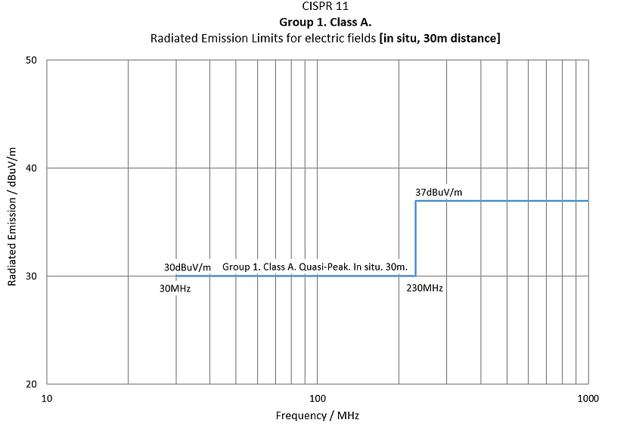
CISPR 11 Group 1 @ in situ:
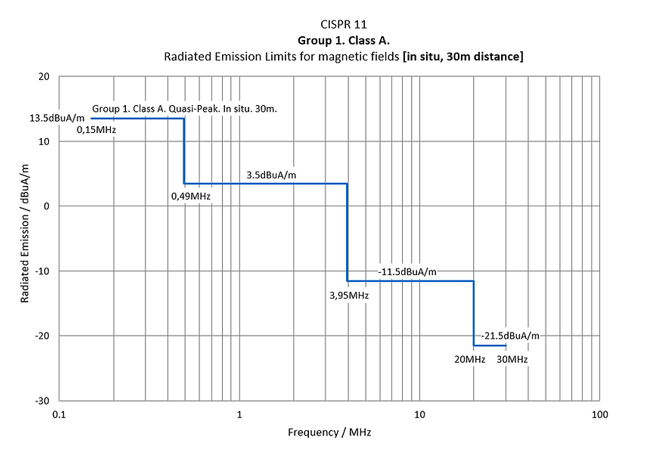
- 150kHz to 30MHz. Magnetic field radiation limits – Group 1 Class A.
- 30MHz to 1000MHz. Electric field radiation limits – for Group 1 Class A.
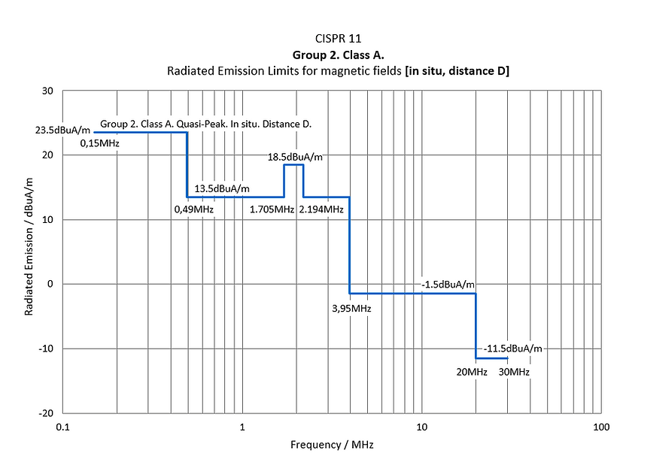
CISPR 11 Group 2 @ in situ:
- 150kHz to 30MHz. Magnetic field radiation – limits for Group 2 Class A.
- 30MHz to 1000MHz. Electric field radiation – limits for Group 2 Class A.

More Links