The IEC/CISPR 32, EN 55032 (Electromagnetic compatibility of multimedia equipment – Emission requirements) is about: Conducted and radiated emissions of signals in the frequency range of 9kHz to 400GHz. CISPR 32 replaced CISPR 13 and the popular CISPR 22 in March 2017.
Applicability.
CISPR 32 applies to multimedia equipment (MME) and having a rated RMS AC or DC supply voltage not exceeding 600 V. Equipment within the scope of CISPR 13 or CISPR 22 is within the scope of CISPR 32. MME intended primarily for professional use is within the scope of CISPR 32. The radiated emission requirements in CISPR 32 are not intended to be applicable to the intentional transmissions from a radio transmitter as defined by the ITU, nor to any spurious emissions related to these intentional transmissions. Equipment, for which emission requirements in the frequency range covered by CISPR 32 are explicitly formulated in other CISPR publications (except CISPR 13 and CISPR 22), are excluded from the scope of this publication. CISPR 32 does not contain requirements for in-situ assessment (in other words: the tests have to be done in an EMC test laboratory). The objectives of CISPR 32 publication are:
- To establish requirements which provide an adequate level of protection of the radio spectrum, allowing radio services to operate as intended in the frequency range 9kHz to 400GHz.
- To specify procedures to ensure the reproducibility of measurement and the repeatability of results.
The CISPR 32 is often referenced by other product and product family standards, outside of the scope defined above.
Classification.
There are two classes of Information Technology Equipment (ITE) defined in CISPR 32:
Class A (higher emission limits, industrial): Devices must have emissions which are below the limits of Class A, but the emissions exceed the limits of Class B.
Class A devices shall have a warning notice in their manual (e.g. “Warning! This is a Class A device. This device may cause radio interference in residential areas; in this case, the operator may be required to take appropriate measures”.).
Class B
- (lower emission limits, commercial): Devices must have emissions which are below the limits of Class B. This is applicable for devices which are used in a residual and domestic environment. In other words: commercial devices. E.g.:
-
- No permanent location (e.g. battery powered devices)
- Telecommunication terminal equipment
- Personal computers
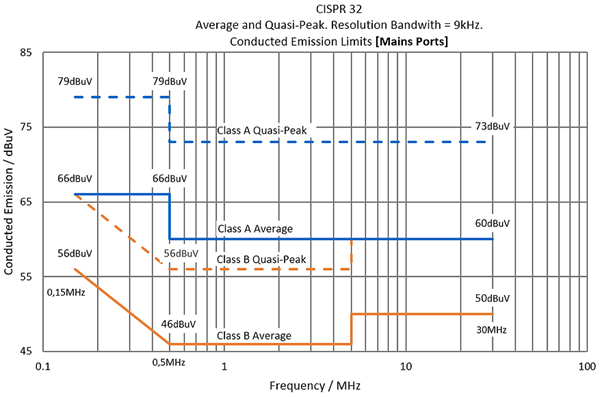
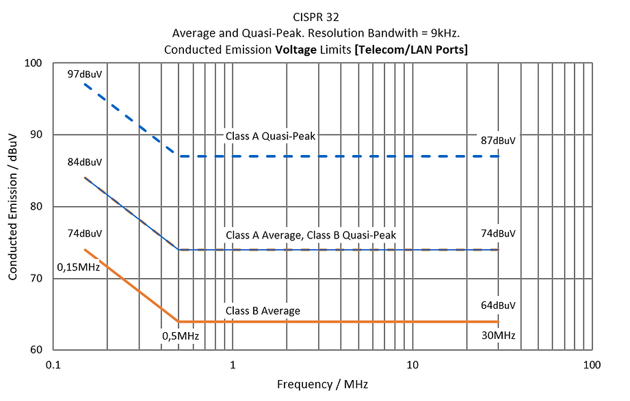
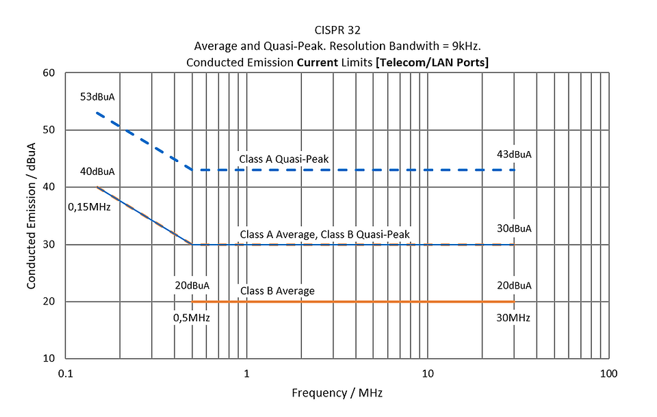
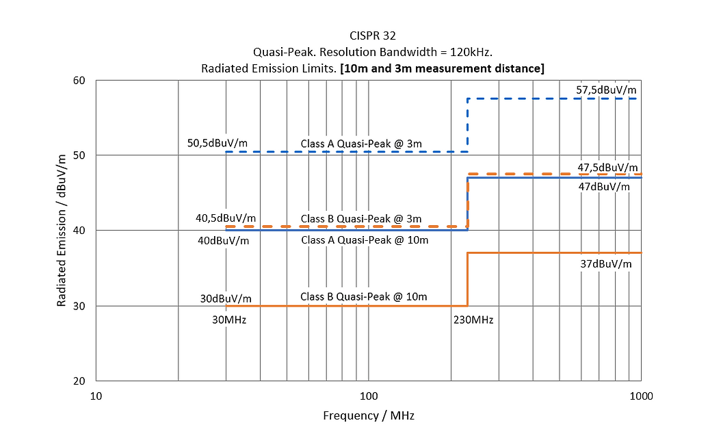
There are limits for conducted and radiated emissions specified in CISPR 32. You can find them in the pictures below. The limits for quasi-peak AND average must not be exceeded by Class A devices (blue) or Class B devices (orange) respectively.
We also added the radiated emission limits for 3m measurement distance, which are in general 20*10log(10m/3m)=10.5dB higher compared to the specified limits for 10m distance. In case you measure at 1m distance (1m distance between Equipment Under Test (EUT) and antenna), the limits are 20*10log(10m/1m)=20dB higher than the 10m limits.

More Links