
Surge Immunity Testing is a type of electrical testing designed to evaluate the ability of electrical and electronic equipment to withstand high-energy voltage surges that can occur on power lines or communication lines. These surges can be caused by various phenomena, including:
1. Lightning strikes (direct or nearby).
2. Switching operations on power grids or circuits.
3. Induced surges from nearby electrical equipment
The goal of surge immunity testing is to ensure that the equipment can function correctly without being damaged when subjected to these types of high-voltage transients.
Why Surge Immunity Testing is Important:
- Electrical Surges: Surges can cause significant damage to sensitive components within equipment, potentially leading to complete failure or reduced lifespan.
- Regulatory Compliance: Many international standards, such as IEC 61000-4-5 and EN 61000-4-5, require equipment to pass surge immunity testing to ensure that products are robust enough for real-world environments.
- Protecting Equipment: Surge testing simulates real-world conditions where surges occur due to external factors, such as nearby lightning strikes or switching of heavy machinery in industrial settings..
Surge Types in Testing:
1) Line-to-Line Surges: Surges applied between two power lines (typically live to neutral or neutral to live).
2) Line-to-Earth (Ground) Surges: Surges applied between a power line and the ground (typically live to earth or neutral to earth).
3) Differential Mode: Surge between two conductors (e.g., live to neutral).
4) Common Mode: Surge between one conductor and the ground (e.g., live to earth).
What Is Tested
Surge immunity testing evaluates how equipment responds to high-energy transient voltages and currents applied to its external ports. The main ports tested typically include:
- AC mains power ports
- DC power input/output ports
- Signal and control lines
- Communication ports (e.g., Ethernet, RS-485)
The test examines whether the equipment:
- Continues to operate normally during and after the surge
- Experiences temporary degradation but self-recovers
- Requires operator intervention to recover
- Suffers permanent damage
Performance criteria (often labeled A, B, C, or D in product standards) define what is considered a pass or fail. For most commercial and industrial equipment, the expectation is either no loss of function (Criterion A) or temporary disturbance with automatic recovery (Criterion B).
-
How It Is Tested
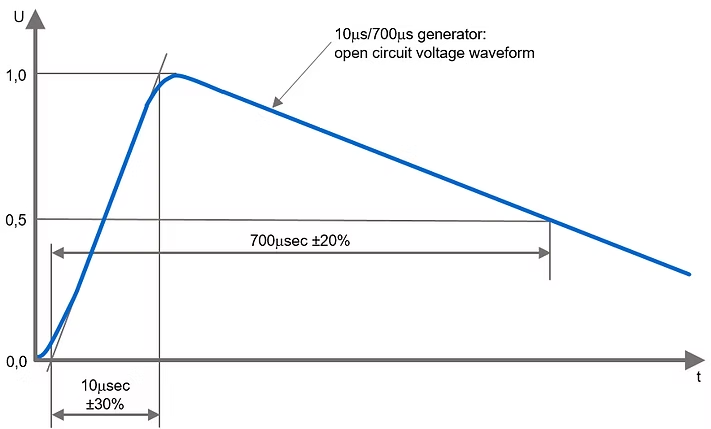
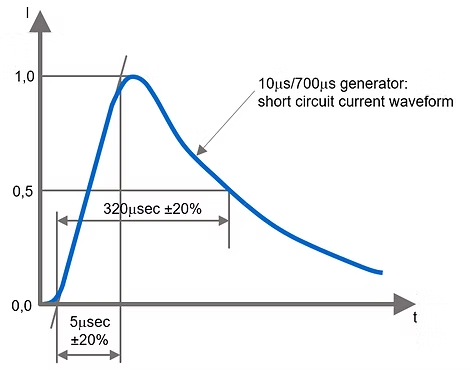
The test uses a surge generator that produces a standardized combination waveform:
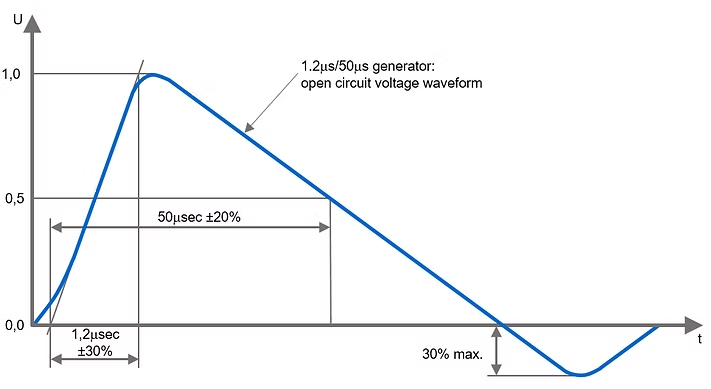
- 1.2/50 µs open-circuit voltage waveform
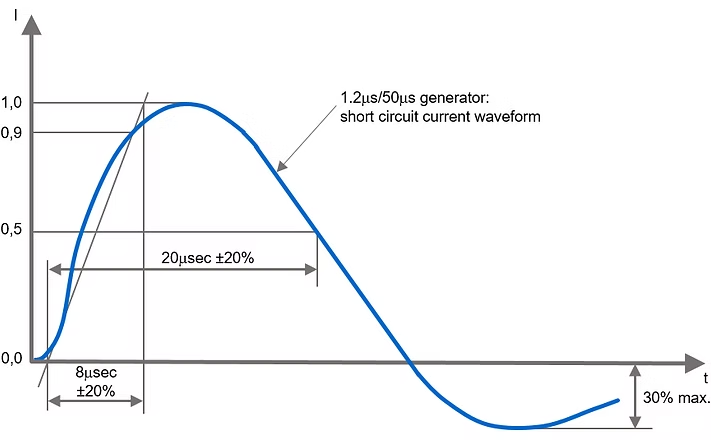
- 8/20 µs short-circuit current waveform
The “1.2/50 µs” waveform means the voltage rises to its peak in 1.2 microseconds and decays to half its peak value in 50 microseconds. When the generator output is shorted, the current waveform follows an 8/20 µs shape (8 microseconds to peak, 20 microseconds to half value). This combination simulates real-world lightning-induced transients on power and signal lines.
Surges are applied using either:
- Direct coupling (for signal and communication lines), or
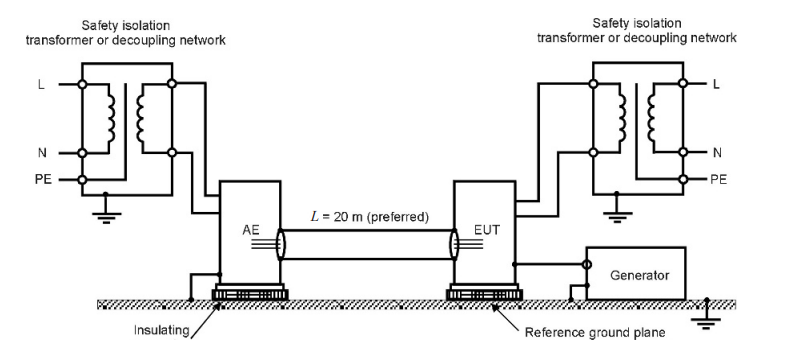
- A Coupling/Decoupling Network (CDN) (for AC or DC power lines).
For AC mains testing, surges are typically applied:
- Line to neutral
- Line to earth
- Neutral to earth
Both positive and negative polarity surges are applied. Multiple pulses (usually at least five per polarity per coupling mode) are injected at specified intervals, often synchronized with the AC mains phase angle (e.g., 0°, 90°, 180°, 270°).
Key Standards:
- IEC 61000-4-5: The international standard for surge immunity testing.
- EN 61000-4-5: The European equivalent of the IEC standard.
- ANSI/IEEE C62.41: Surge testing standard used in North America.
Test Environments:
- Residential: Typically tested with lower surge levels (e.g., 1 kV).
- Industrial: Higher surge levels (e.g., 2 kV or 4 kV) are used to simulate harsher environments where equipment is more likely to face high-energy transients.
Results of Surge Immunity Testing:
- Pass: The equipment continues to function as intended without degradation or failure.
- Fail: The equipment either malfunctions or is damaged. Failures can be due to damage to internal components or loss of functionality, and the equipment may require design modifications to improve its immunity to surges.
Surge immunity testing to IEC 61000-4-5 is a standardized test method used to evaluate how well electrical and electronic equipment can withstand high-energy transient over voltages, commonly known as surges. These surges are typically caused by indirect lightning strikes, switching of large inductive loads (such as motors or transformers), or power system faults. The purpose of the test is not to determine whether a product can operate during a direct lightning strike, but whether it can survive and continue functioning correctly when exposed to realistic surge conditions likely to occur in normal installations.
The standard that defines this test method is IEC 61000-4-5, which forms part of the broader IEC 61000 series for electromagnetic compatibility (EMC). IEC 61000-4-5 specifically describes the waveform characteristics, test equipment, coupling methods, and severity levels used to simulate surge events. It is widely referenced in product standards for industrial, commercial, residential, and telecommunications equipment around the world.
Test Levels and Limits
IEC 61000-4-5 defines standard severity levels. The actual level required depends on the product category and installation environment, as specified in the relevant product standard.
For power ports, typical test levels are:
- Level 1: 0.5 kV (line-to-line), 1 kV (line-to-earth)
- Level 2: 1 kV (line-to-line), 2 kV (line-to-earth)
- Level 3: 2 kV (line-to-line), 4 kV (line-to-earth)
- Level 4: 4 kV (line-to-line), 4 kV or higher (line-to-earth)
For signal and communication lines, typical levels are:
- 0.5 kV
- 1 kV
- 2 kV
Industrial equipment often requires Level 3 performance, while residential equipment may require Level 2. Outdoor equipment or equipment installed in exposed industrial environments may require higher levels.
The “limit” in surge testing is not a strict emission limit (as in emissions testing), but a performance-based requirement. The equipment must meet the defined performance criterion at the specified test level. If it resets, locks up permanently, loses stored data, or suffers damage beyond the allowed performance category, it fails.
Practical Considerations
In real-world design, surge immunity is typically achieved using:
- Metal Oxide Varistors (MOVs)
- Transient Voltage Suppression (TVS) diodes
- Gas discharge tubes (GDTs)
- Proper earthing and bonding
- Input filtering and isolation
Designers must consider coordination between protective devices so that surge energy is safely diverted without overstressing components downstream.
Summary
Surge immunity testing under IEC 61000-4-5 assesses a product’s ability to withstand high-energy transient over voltages caused by lightning and switching events. It evaluates power and signal ports using standardized waveforms and severity levels. The test ensures that equipment placed on the market—particularly in industrial and commercial environments—can survive realistic electrical disturbances without unacceptable degradation or permanent damage.

Home – Latest Standards – FCC vs CISPR – Fast Transient Bursts – GDPR