
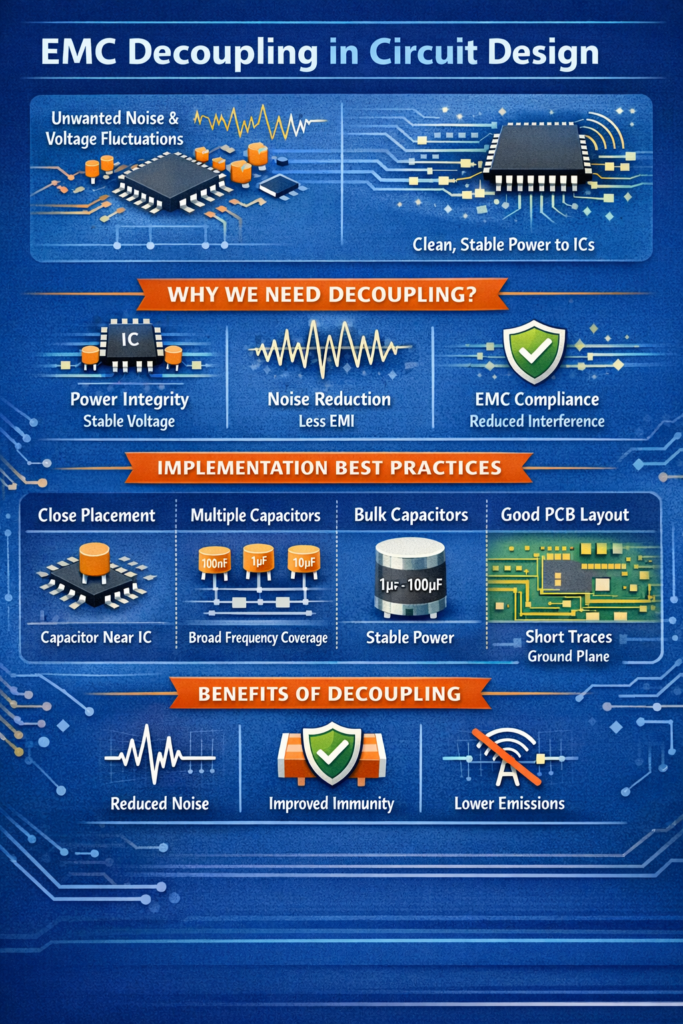
In EMC (Electromagnetic Compatibility) design, decoupling (also called bypassing) is the practice of placing capacitors and other components in a circuit to control unwanted noise and stabilize voltage at active devices. In real circuits, power and ground are not ideal—they have resistance, inductance, and impedance that allow voltage fluctuations and high-frequency noise to develop. When digital ICs switch, they draw very fast, short bursts of current. Without decoupling, these current spikes create voltage ripple on the supply rails, which can cause malfunction, timing errors, increased electromagnetic emissions, and susceptibility to interference. Decoupling ensures that each device sees a clean, stable power supply, even during rapid switching events.
We need decoupling primarily for three reasons: power integrity, noise reduction, and EMC compliance. First, fast switching devices (such as microcontrollers, FPGAs, or processors) can generate high di/dt currents. According to V=L di/dt even small parasitic inductances in PCB traces can create significant voltage spikes. Decoupling capacitors act as local energy reservoirs, supplying instantaneous current and minimizing voltage droop. Second, they reduce conducted and radiated emissions by shunting high-frequency noise to ground before it propagates across the board or into cables. Third, they improve immunity by preventing external noise from disturbing sensitive circuits. In short, decoupling improves stability, signal integrity, and compliance with EMC standards.
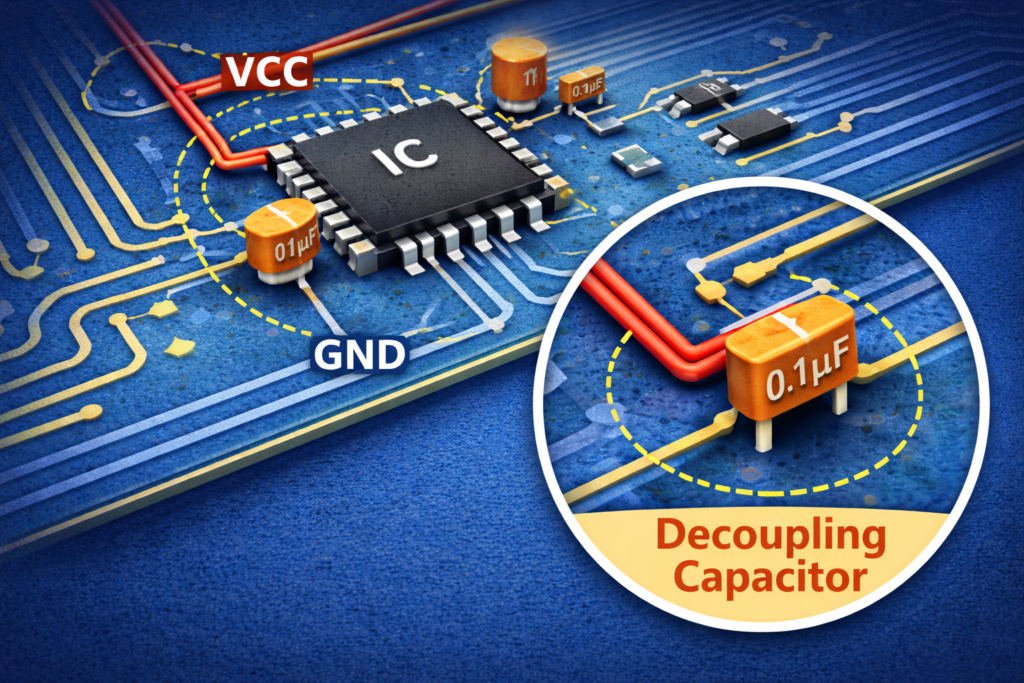
Implementation of decoupling in circuits follows several best practices. The most important rule is placement: decoupling capacitors must be placed as close as possible to the power pins of the IC, with very short traces to minimize inductance. Typically, a small ceramic capacitor (for example, 100 nF) is placed at each power pin to handle high-frequency noise. In addition, larger bulk capacitors (such as 1 µF to 100 µF) are placed nearby to support lower-frequency transients and overall supply stability. Modern multilayer ceramic capacitors (MLCCs) with low ESR (Equivalent Series Resistance) and low ESL (Equivalent Series Inductance) are preferred for high-frequency decoupling.
Another key consideration is the use of multiple capacitor values in parallel. Different capacitor values are effective at different frequency ranges. A 100 nF capacitor handles very high frequencies, while a 1 µF or 10 µF capacitor covers lower frequencies. By combining them, designers achieve broadband decoupling across a wide spectrum. Proper PCB layout is equally critical—solid ground planes, short return paths, and minimizing loop areas all reduce impedance and improve decoupling performance. In high-speed or high-power designs, designers may also use ferrite beads to create power supply filtering sections, isolating noisy subsystems from sensitive ones.
Decoupling in EMC design is about controlling power distribution network impedance and preventing unwanted noise from affecting circuit operation or escaping as emissions. It is essential in modern electronics due to high switching speeds and dense PCB layouts. Good decoupling practice—correct capacitor selection, strategic placement, and careful PCB layout—ensures reliable operation, reduced interference, and successful EMC performance.
Typical Self-Resonant Frequencies of MLCC Capacitors
| Capacitor Value | Typical SRF Range | Effective Frequency Range (Good Decoupling) |
|---|---|---|
| 100 pF | 300 MHz – 1 GHz+ | Very high RF / GHz noise |
| 1 nF | 100 – 300 MHz | High RF suppression |
| 10 nF | 30 – 100 MHz | High-frequency digital edges |
| 100 nF (0.1 µF) | 10 – 30 MHz | General high-frequency decoupling |
| 1 µF | 3 – 10 MHz | Mid-frequency transients |
| 4.7 µF | 1 – 5 MHz | Lower-frequency ripple |
| 10 µF | 500 kHz – 2 MHz | Bulk local decoupling |
| 47 µF (MLCC) | 100 – 500 kHz | Low-frequency supply smoothing |
| 100 µF (electrolytic/polymer) | 10 – 200 kHz | Bulk power filtering |
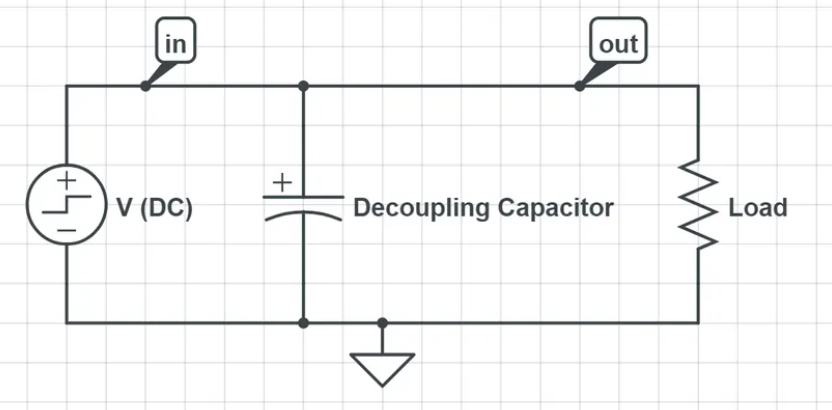
Circuit with a Decoupling Capacitor Fitted


Home – Latest Standards – FCC vs CISPR – Fast Transient Bursts – GDPR – EMC Screen Termination