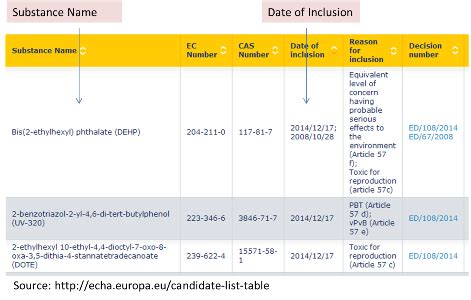
On 4 February 2026, the European Chemicals Agency (ECHA) published an update to the REACH Candidate List of Substances of Very High Concern (SVHCs). With this update, two additional substances were added, increasing the total number of SVHC entries to 253. The Candidate List is a key element of the EU’s chemicals regulation framework under REACH Regulation (EC No 1907/2006), aimed at identifying substances that may have serious effects on human health or the environment.
Substances are placed on the Candidate List when they meet the criteria set out in Article 57 of REACH, such as being carcinogenic, mutagenic, toxic to reproduction, persistent, bioaccumulative and toxic, or of equivalent concern (for example, endocrine disruptors). Once listed, companies that manufacture, import or supply these substances—either on their own, in mixtures, or within articles—face immediate compliance obligations.
In practical terms, suppliers must inform downstream users and consumers if an SVHC is present in an article above 0.1% weight by weight, and provide sufficient information to allow safe use. Companies may also have notification duties to ECHA, including submissions to the SCIP database under the Waste Framework Directive. Beyond communication requirements, listing can be a first step toward eventual inclusion on the Authorisation List, which would mean continued use in the EU would require specific regulatory approval. As a result, each update to the Candidate List can have significant supply chain and compliance implications for businesses operating in or exporting to the EU.
In the 4 February 2026 update to the REACH Candidate List, the European Chemicals Agency (ECHA) added two new substances of very high concern (SVHCs), bringing the total number on the list to 253.
The first substance added was n-hexane, a widely used industrial solvent. It was identified as an SVHC due to its specific target organ toxicity following repeated exposure, particularly its harmful effects on the nervous system. n-Hexane is commonly used in applications such as adhesives, coatings, cleaning agents, and polymer processing, meaning the listing may have implications across several manufacturing sectors.
The second addition was 4,4′-[2,2,2-trifluoro-1-(trifluoromethyl)ethylidene]diphenol and its salts, better known as bisphenol AF (BPAF). This substance was included because of its reproductive toxicity. BPAF is typically used in certain high-performance plastics and resins, including as a cross-linking or process agent. Its inclusion reflects ongoing regulatory scrutiny of bisphenol-type substances due to their potential health impacts.
As with all Candidate List additions under the REACH Regulation (EC No 1907/2006), companies placing these substances on the EU market now face immediate communication and, where applicable, notification obligations.
andidate List of substances of very high concern for Authorisation – ECHA
https://echa.europa.eu/candidate-list-table
PFAS restriction under the REACH framework
REACH 4 February 2026 Candidate Update
Recent EMC Standards Removed from the Harmonised List
Updated Standard

New and Revised Standards for EMC Measurements
ECHA Publishes February 2026 REACH SVHC Update: Two New Substances Added